
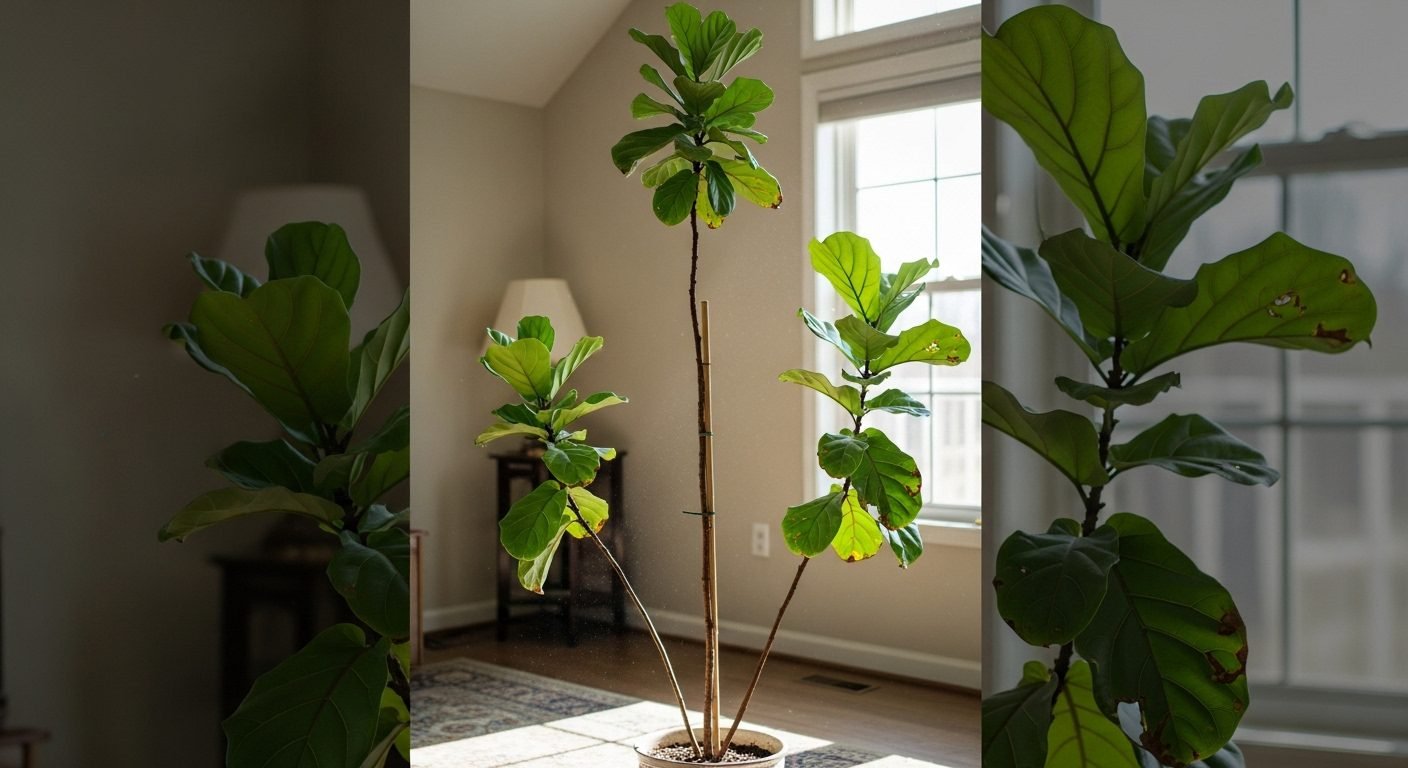
A leggy fiddle leaf fig is one of the most common frustrations for plant owners. Instead of a full, leafy tree, the plant grows tall with long bare stems and only a few leaves at the top. The good news? A leggy fiddle leaf fig isn’t unhealthy it’s simply asking for better conditions.
This guide explains what causes legginess in a fiddle leaf fig (ficus lyrata) and the exact steps to make the plant fuller and more balanced again.
What Does “Leggy” Really Mean?
Plant experts use the term leggy fiddle leaf fig when:
- Stems grow long with big gaps between leaves
- New leaves appear small or sparse
- The plant leans toward one direction
- Lower leaves drop off over time
This is almost always a light-related growth pattern rather than a disease.
The Main Cause: Not Enough Light
Insufficient light is the #1 reason a fiddle leaf fig tree indoor becomes leggy. The plant stretches toward the nearest light source, creating long, weak stems.
How to fix it
- Move the plant closer to a bright window
- Provide consistent indirect sunlight
- Rotate the plant weekly
👉 Helpful option:
Many growers find a full-spectrum grow light extremely useful in darker homes or during winter. It prevents stretching and encourages tighter leaf growth.

- [MODERN STYLE FULL SPECTRUM GROW LIGHTS] Our versatile LED grow light nurtures your plants with red, white and IR & UV L…
- 【PERSONAL PLANT ASSISTANT】Auto-timer function ensures consistent care for your plants,The indoor plant grow light’s time…
- 【MULTIFUNCTIONAL REMOTE CONTROL】Our plant lights come with a multifunctional remote control that intuitively displays al…
Pruning to Encourage Branching
A leggy plant needs shaping. Strategic pruning signals the fiddle leaf fig to create new branches instead of one tall stem.
Simple pruning method
- Choose a healthy section
- Cut just above a leaf node
- Wait for 2–3 new shoots
👉 Useful tool:
Sharp pruning shears make clean cuts that heal faster and reduce stem damage.
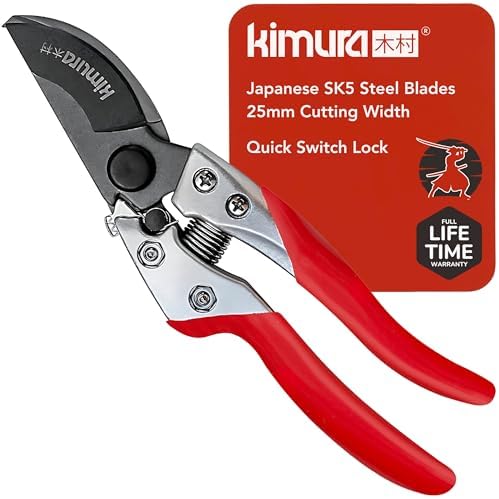
- [ HIGHLY VERSATILE ] – These professional heavy duty pruning shears equip you with all you need to cut through 1″ thick …
- [ SHARP & PRECISE ] – The sharp SK5 Steel blades are forged in Japan and heat treated to 60 HRC ensuring long-lasting ed…
- [ ERGONOMIC DESIGN ] – The aluminium handles are lightweight, ergonomic and coated in Non-Slip PVC for enhanced comfort …
Try the Notching Technique
Notching is a professional trick used to fix a leggy fiddle leaf fig plant without cutting the top.
- A tiny nick is made above a node
- The plant responds by forming a branch
- Great for filling empty middle sections
This works well for fiddle leaf fig tree indoor living rooms where appearance matters most.
Correct Watering Matters Too
While light is the main factor, poor watering can worsen legginess.
- Overwatering → weak growth
- Underwatering → leaf drop
- Inconsistent care → long bare stems
Stable fiddle leaf fig care routines create stronger, closer leaf spacing.
Fertilizer and Growth Support
During spring and summer, gentle feeding helps the plant push out fuller leaves instead of thin stretched ones. Experts recommend light, regular nutrition rather than heavy doses.
Rotate for Balanced Shape
If the plant always faces one direction, it becomes uneven and leggy. Rotating weekly keeps the tree aesthetic balanced and upright.
Be Patient with Recovery
Fixing a leggy fiddle leaf fig takes time. New growth will look better first, while old bare stems may remain until pruned or branched.
Most plants show improvement within:
- 4–6 weeks with better light
- 6–10 weeks after pruning or notching
Quick Action Plan
- Increase bright indirect light
- Prune or notch to trigger branches
- Rotate weekly
- Keep watering consistent
- Feed during growth season
Final Thoughts
A leggy fiddle leaf fig is not a failure—it’s simply a plant communicating its needs. With better light and a little shaping, even the stretchiest fiddle leaf fig can become a full, impressive indoor tree again.